





















Workshop
AI Content Creation Workshop
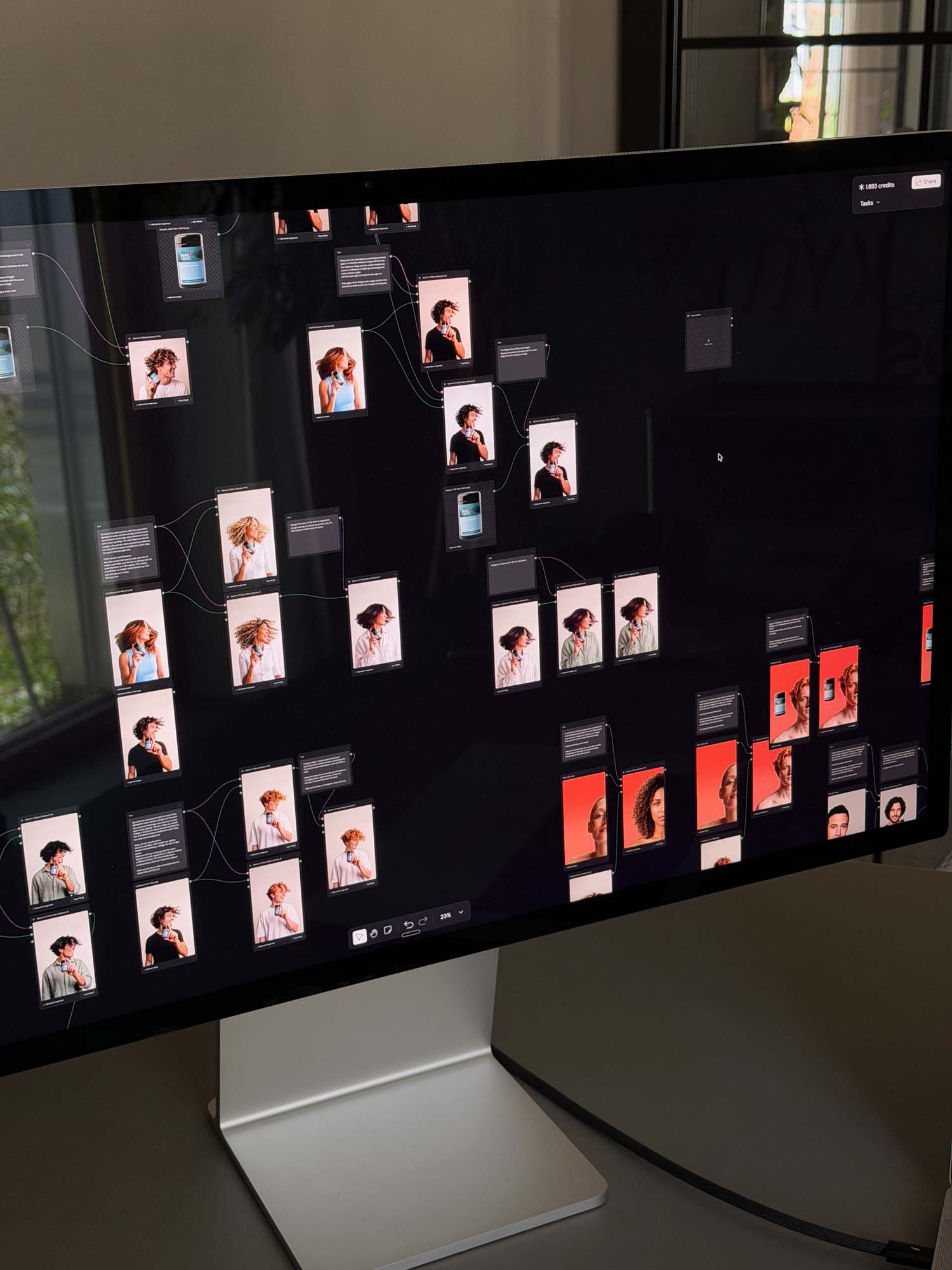
Learn how to align generative AI with your brand, uncover your best use cases, and build scalable, in-house content workflows your team can run on day one.
Request price
Brand DNA & AI Alignment
Use-Case Mapping & Opportunity Analysis
Advanced Prompt Engineering & Frameworks
End-to-End Workflow Architecture
Tool Stack, Governance & Ethics
-0%
-0%
Average reduction of costs linked to content creation.
+0%
+0%
Increase in interaction, due to extended creative capabilities, shorter iteration cycles and new dimensions of testing opportunities.
0x
0x
The creative output on a wider range of our mandates has increased ten-fold.
0%
0%
Reduction in lead time from initial creative concept to campaign launch.
Can people distinguish between AI content and camera-shot content?
When art-directed carefully, AI-generated content is often indistinguishable from traditional production. The outcome depends both on the tool and on creative direction, refinement, and integration within a coherent brand world.
Do you handle prompting in-house?
Yes. Prompt development is treated as a creative discipline within our process. We build structured prompt frameworks and iterate internally to ensure outputs align with brand, concept, and usage context.
Do you produce content featuring real faces or people from our brand?
We can work with both synthetic and real individuals. Projects may combine AI-generated talent, licensed models, or client-provided photography, depending on authenticity requirements and brand considerations.
How do you ensure brand consistency in AI content?
Consistency is achieved through defined visual systems, prompt frameworks, and curated asset libraries that guide generation and maintain recognisable brand expression.
What does AI content creation cost?
It depends on how you work with us. A workshop gets your team running its own AI content workflow. A retainer covers a recurring monthly volume of social ad creative. A project delivers a defined asset pool, for example an art-directed image library. The cost logic differs from a classic shoot: you are not paying for a set day, a crew and a location, you are paying for art direction, prompt engineering and curation. Tell us the volume and formats you need and we will give you a straight number.
Who owns the rights to the assets you produce?
You do. Everything we deliver is handed over for your commercial use. Where a project includes licensed models, existing brand photography or third-party reference material, the terms of those licences carry through, and we flag that before production rather than after. If your legal team needs documentation of how an asset was produced, we can provide it.
Do we have to label AI-generated advertising?
It depends on where the campaign runs. Switzerland has no general labelling duty for AI-generated advertising today, but the EU AI Act brings transparency obligations for synthetic content from 2 August 2026, which matters as soon as you serve the EU. Several ad platforms also set their own disclosure rules, particularly for political advertising and realistic depictions of people. We track the requirements for your markets and build the handling into production. For binding advice, talk to your legal counsel.
How long does a project take compared to a classic shoot?
Much shorter, because the slow parts disappear. No casting, no location scouting, no set day, no waiting on retouching. Across our own mandates, lead time from initial creative concept to campaign launch has dropped by 75%. What does not compress is the thinking at the front: brand system, concept and art direction still take the time they take, and that is the part worth protecting.
Which tools do you use?
We stay deliberately tool-agnostic. The model landscape changes every few months, and locking a brand into one generator is a liability, not a strategy. We pick per use case: image or video, realism or stylisation, product accuracy or atmosphere. What carries over between tools is the part we build for you, the prompt frameworks, reference libraries and brand rules that keep output consistent whatever runs underneath.
Where does AI content still reach its limits?
Hands and fine motor detail still fail regularly. Text inside an image is unreliable, so logos and packaging copy usually need a production step afterwards. Material truth is hard: specific fabrics, brushed metal, liquids and transparency often look almost right, which is worse than obviously wrong. Keeping one face consistent across a whole campaign takes real work. And any factual claim in a regulated field, health, finance or food, needs human verification before it goes near a media budget.